
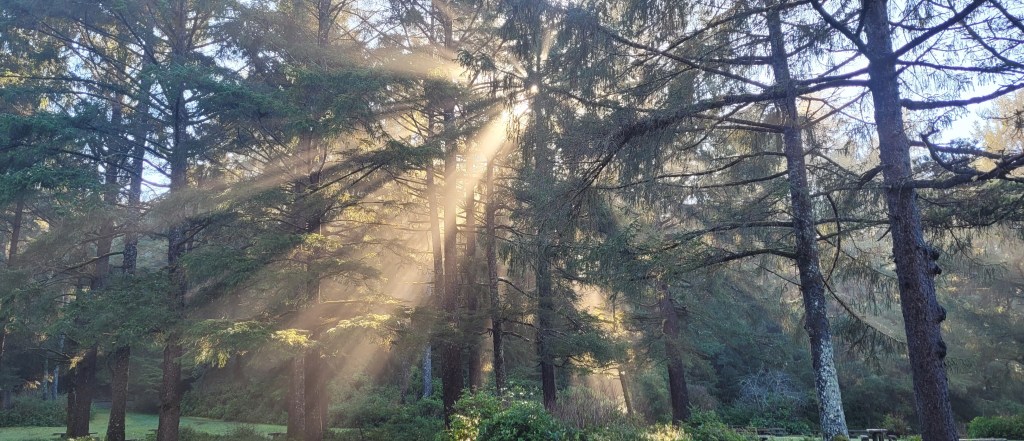
My daughter was approximately 16 years old when she got into hiking. Being a Gen Z’er, she grew up in a world where technology, social networking, and the more sedimentary lifestyle was the norm. Me, a Gen X’er, grew up in the hybrid world. I could easily bounce back and forth between the addiction of a social media and leaving my cell phone at home to enjoy the ‘unavailable’ status. She passed the time playing her Nintendo Cube while I grew up playing in the pecan orchard separating my home from the home of my grandparents. Not that she spent all her time indoors, though; Quite the contrary. She spent much of her early years in the outdoors, but as she took on her tween and teen years, she spent a chunk of it disconnected from nature. But as she grew to prefer the outdoors, and with me acquiring a hiking buddy, I saw considerable differences begin emerging the more time she spent in nature.
One day, she said to me, “Mom, lets go get some Dirt Therapy this weekend.” We started using this phrase anytime we wanted to do some sort of activity that engaged us with the outdoors. I asked her one day why the sudden interest in hiking. Her answer was one I’ll never forget. She said “Mom, the rocks don’t care if I have social anxiety. The trees don’t care if I wear make-up.” I’ve always known that being outside made me feel good. It didn’t matter if it was planting, climbing trees, sitting in the grass, hiking, foraging, fishing, or snow skiing – I just felt better in nature. But this was a new and different perspective for me.
So, I started wondering… why? Why did I feel good in the outdoors? Why did she feel better outdoors? What was the actual biological, psychological reason why? The answers started with my research into Shinrin-Yoku, which translates to Forest Bathing and grew from there. I know, I know. Sounds like a kumbaya, incense burning, tree-hugging hippy fest, but stay with me here. Dr. Qing Li, who literally wrote the book on Forest Bathing, began doing research on the effects of nature on our bodies back in 2004. Thanks to his research, we now know that nature has a profound impact on the human body. The hippies get it. Our Indigenous ancestors have always kept nature in the forefront of their culture. I think the rest of us have just slowly evolved with the times, migrating further and further away from that connection. While I’m sure that the last few years of the Covid-19 pandemic have altered the numbers, the overall data still shows that the vast majority of our population still resides in urban areas.
So let’s talk about our relationship with nature.
Before there were 3 br/2 ba homes with heated floors, walk-in his closets, soft-close drawers, farmhouse sinks, and central air, there were simply humans, animals, and the Earth. Humans have lived immersed in nature much, much longer than inside the structures we now have and structures of the past. In fact, 99.5% of our existence has been spent in natural environments. Clearly, this would have a profound impact on us, as a species. And the truth is, we seek nature.
Give it a thought. When you book a vacation, do you look for a room with a view? When you take a Sunday drive, do you take the scenic route? Do you hunt ONLY for the game or does nature play a factor? Do your children prefer to play in the streets or in a park setting? Do you prefer working with natural materials (wood, stone, clay) or would you rather work with plastics? Do you garden for the sole purpose of growing food, or do you do it because you enjoy your hands in the dirt, the sunshine on your face, the smell of turned dirt, and the miracle of the growth?
Your answers to these questions can be explained by one simple term. Biophilia. While it started out having a slightly different meaning, the Biophilia Hypothesis was founded by the original ‘Ant Man’, Dr. EO Wilson. It is defined as the natural-born tendency to connect with nature and other living beings. Dr. Wilson wrote that we are hard-wired to affiliate with the natural world – just as our health improves when we are in it, so our health suffers when we are divorced from it. Let’s think about that for one minute. Natural. Born. Tendency. In other words, nature is in our DNA. We are born connected to nature.
History has shown that our bond with nature is unbreakable. Let me give you a couple of interesting facts. The scientific community agrees that the human eye can distinguish between a few dozen shades of any given color. However, when it comes to the most common color in nature, humans can distinguish around 100 different shades. I’m sure I don’t have to tell you what that color is. The Journal of the Acoustical Society of America found that humans react the fastest to the sounds of predatory animals before the sounds of artificial alarms (cars, theft alarms, etc). If I were to show you two different sets of photos, one set with spiders, centipedes, scorpions, and snakes and one set with knives, guns, axes, and ball bats, you’re going to react more viscerally to the creepy crawlies. In fact, it’s been proven through analogous experiments. You see? You can disassociate with nature and still be hardwired to connect with it.
Now, let’s really get into it.
Vast studies have been done to show the impact nature has on our bodies, our mental well-being, and our behaviors. When we are actively engaged in nature, there is a natural act of reciprocity. We benefit physically, emotionally, spiritually, and socially. Nature benefits because our compassion for our environment grows, thus growing our awareness for conservation (at least this was the hope of EO Wilson). While science has yet to discover the actual gene responsible, we know the outcomes. Nature, any landscape of nature, affects every part of us; The cardiovascular, endocrine, the nervous, immune and metabolic system, our cortisol levels and glucose levels, just to name a few. Nature releases the three amigos of happy hormones (serotonin, dopamine, endorphins) and makes us more compassionate, patient, and social. Nature also has an effect on our spirituality too. Have you ever seen those memes with a picture of nature captioned “This is my church.”? And truly, it doesn’t matter what your religion, spiritual status, or background happens to be. Nature is imbedded in spirituality. Or maybe spirituality is imbedded in nature. Who know? We’ll get into specifics later, but the point is, it’s worth exploring knowing that this relationship is a two-way beneficial street.
And listen, y’all, I’m not here to tell you that nature is the cure for all things that ail you. As someone who deals with a set of physical illnesses all of my own, I’m of the opinion that your health is essentially a stool with several legs that hold up the optimal state of health. If I sit on my bench and I’m not maintaining the legs of that stool, I’m going downhill in a hurry. And everyone’s stool might have legs that consist of different elements, the number of legs, or how much weight each of those legs carries. My stool has four legs (at the moment) that consist of Dirt Therapy, Diet, Physical Therapy, and Medications/Supplements.
You’ll notice, though, how nature is incorporated in every single leg. My supplements are as natural as I can get them. Physical therapy happens pretty frequently in the outdoors. I try to eat as many natural things as possible – though I’m from the south and comfort foods are my weakness. (Hello, chicken ‘n dumplins?) And Dirt Therapy IS my church, my sanctuary, my escape, the place where I can just be.
So, friends, as we work to create meaningful content, my hope is to help you to get outside, know and reap the benefits, and maybe even develop that give and take relationship with the world outside of our own existence. It’s an amazing space, really.
Also, big thanks to the books, studies, and authors that have given me the answers and information I’ve acquired thus far. My favorites have been Forest Bathing by Dr. Qing Li, The Secret Therapy of Trees, by Marco Mencagli and Marco Nieri, and the studies by Dr. Qing Li, Dr. EO Wilson, and others that will be used in later posts. I have many more on my read list but I will get to those when I can.
~ Misty
Peace.Love.Dirt

 Dirt Therapy